
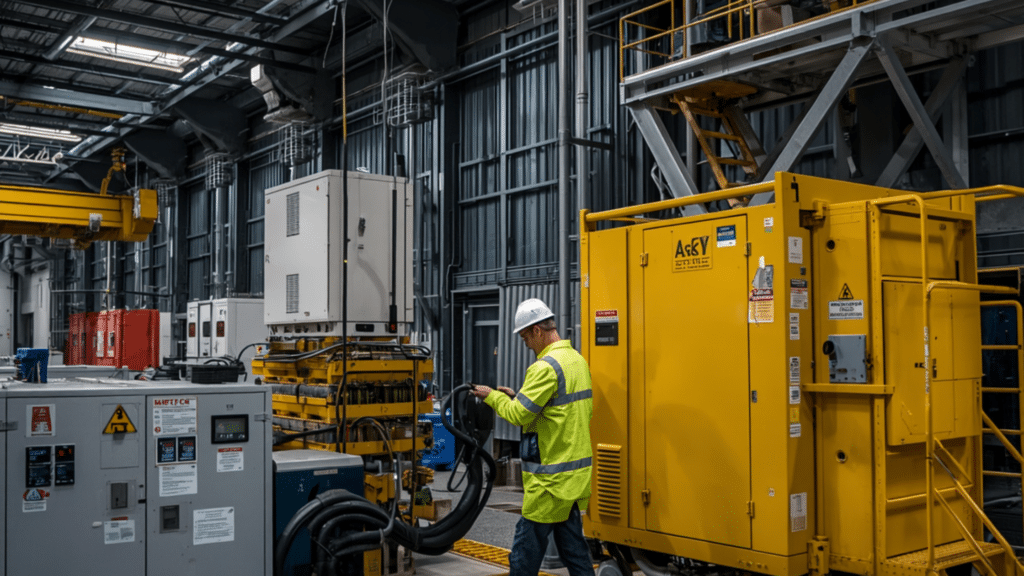
In the fast-paced environment of UK manufacturing, power is the lifeblood of production. Whether you are planning a significant switchgear upgrade, expanding a production wing, or experiencing a temporary increase in demand, a robust energy plan is a non-negotiable requirement.
However, temporary site power solutions in the UK are not as simple as hiring a generator; they require a detailed understanding of your facility’s electrical load and the technical risks associated with off-grid power supplies.
At Process Control Services UK Ltd (PCS), we have seen how a poorly specified temporary system can lead to damage of expensive equipment, dirt in your SCADA systems, and even total production shutdowns.
Here are four steps to choosing the right setup.
Step 1: Calculate Your True Peak Load
The most common mistake in temporary power procurement is underestimating the Inrush Current. While your machines might run at a steady amperage, the moment a large motor or compressor starts, it can pull up to seven times its running current.
If your temporary supply isn’t rated for these spikes, the voltage will dip, causing your entire control system to trip. To avoid this, PCS recommends:
- Conduct a Load Profile Study: Don’t guess based on the nameplate; actually measure your peak demand over a set period of time.
- Account for Diversity Factors: Not all equipment runs at once. Understanding your Maximum Demand will help you select an efficient generator, not one that is oversized.
Step 2: Ensure Grid-Quality Power for Sensitive Electronics
Modern Smart Factories are packed with sensitive PLCs, HMI screens, and variable speed drives (VSDs). Unlike the stable UK grid, a temporary generator is a soft power source. This means it is prone to harmonic distortion and voltage transients that can fry delicate circuit boards.
To protect your Industry 4.0 assets, look for systems that incorporate surge protection in the UK to block high-voltage spikes during switching. Without this protection, a minor fault in the temporary rig can result in a permanent failure of your expensive automation hardware.
Step 3: Synchronisation vs. Standalone Units
In heavy-duty process environments such as cement plants or large-scale food production, a single large generator is often less efficient than a Synchronised Power Farm. Using multiple smaller units allows for:
- Load Sharing: The generators adjust their speeds to match load demand, thereby reducing fuel costs.
- N+1 Redundancy: Even if a generator is taken for service or develops a fault, the other generators will ensure your production line continues running.
- Bumpless Transfer: The synchronisation panel allows you to switch back to the grid supply without a blackout.
Step 4: Don’t Overlook Earthing and Compliance
A temporary installation must still meet the rigorous standards of BS 7671 (18th Edition). Many sites fail audits because their temporary earthing (often a TT system with earth rods) hasn’t been properly tested for Earth Loop Impedance.
Every PCS installation focuses on three compliance tiers:
- RCD Discrimination: Ensuring that a fault in one small area doesn’t trip the main breaker for the whole plant.
- Cable Management: Using heavy-duty
ramps and correctly rated trailing cables to prevent mechanical damage in high-traffic zones. - Ingress Protection (IP): Ensuring all distribution boards are rated for the environment, whether that is a dusty flour mill or a damp outdoor yard.
Step 5: Fuel Management and Remote Monitoring
A temporary power solution is only as good as the fuel supply that runs it. In a 24/7 operation, running out of diesel is a catastrophe that can be prevented with a bit of planning. A temporary solution should include:
Telemetry Systems: A system that will send a signal to the engineering team when fuel supplies fall to 25%.
Environmental Protection: Double-bunded fuel tanks that will not contaminate the ground, thus complying with UK regulations.
Final Thoughts
Choosing the right temporary power is about protecting your machinery and staying audit-ready.
Do you need a technical audit of your temporary power requirements? Contact Process Control Services UK Ltd (PCS) at 01298 79969 or email our engineering team at sales@pcsukltd.co.uk to discuss your project.